
How to Stop Overthinking Business Decisions: A Founder’s Guide

Your balance sheet looks healthy. Your mind feels bankrupt. You have built something substantial, yet you spend your evenings trapped in a loop of "what-if" scenarios. It is a quiet, heavy exhaustion. Recent research from 2026 shows that 85% of business leaders suffer from "decision distress," second-guessing themselves even after the choice is made. You aren't lacking information. You are lacking a system.
It is time to stop overthinking business decisions and bridge the clarity gap that stalls your growth. We agree that hesitation is a silent tax on your operations. The mental drag of reversible choices is costing you more than just sleep; it is costing you strategic momentum. This guide provides the high-performance frameworks needed to reclaim your focus. We will explore how to accelerate your decision cycles and find the mental space required for true vision. You will learn to move with the quiet confidence of a founder who has mastered their inner game.
Table of Contents
The Anatomy of Analysis Paralysis in Leadership
Your revenue is climbing. Your sleep is declining. On the surface, the company is thriving. Inside, you are stalling. This state of Analysis paralysis isn't a lack of intelligence. It is a lack of structure. Overthinking is rarely about the data. It is a mask for the fear of being seen as wrong. You are trying to protect your reputation. You are actually eroding your leadership. Every hour spent waffling is an hour of lost momentum. You need to stop overthinking business decisions to close the Clarity Gap. This is the distance between the noise in your head and the vision you once held so clearly.
Why Founders Are Prone to Decision Fatigue
Growth brings complexity. This is the Founder's Paradox. Your past success has earned you more difficult choices, not easier ones. The isolation of the C-suite amplifies the volume. There is no one left to tell you what to do. This creates "open loops." These are unfinished thoughts that drain your cognitive battery. Carrying these loops has a biological cost. It leads to mental exhaustion and a fractured presence. Research indicates that 57% of C-suite leaders are spending more time deliberating critical choices than they did just a few years ago. It is a quiet, heavy tax on your potential.
The High Cost of the "Perfect" Plan
Perfectionism is just procrastination in a suit and tie. It looks professional. It feels like due diligence. It is actually a delay tactic. Waiting for 100% certainty is a death sentence for innovation. Market timing doesn't wait for your comfort. You are looking for a guarantee that doesn't exist. For a Montreal entrepreneur navigating a high-growth phase, the opportunity cost of hesitation is often higher than the cost of a corrected mistake. If you wait for the "perfect" plan, the window of opportunity has already closed. You don't need more certainty. You need more movement.
The weight of indecision is visceral. It sits in your chest during board meetings. It follows you home to the dinner table. To stop overthinking business decisions, you must first recognize that "perfect" is a moving target. True leadership is found in the ability to act while the fog is still thick. You are not paid to be right 100% of the time. You are paid to keep the ship moving forward.
The 51% Rule: Shifting from Accuracy to Momentum
The board expects a roadmap. You feel like you're staring into a blizzard. This is the moment where momentum is won or lost. To stop overthinking business decisions, you must adopt the 51% Rule. If you have a slight majority of the data, you have enough to act. Waiting for the remaining 49% doesn't reduce risk. It only delays the inevitable. Momentum is your most valuable currency. Do not spend it on the pursuit of total certainty.
Decouple your identity from the outcome. Your business is a laboratory. Each choice is an experiment, not a final verdict on your competence. When you view decisions as data-gathering exercises, the weight of being "right" evaporates. You become a scientist of your own strategy. This is Grounded Authority. It is the ability to lead through the fog without pretending it isn't there. You aren't seeking a perfect path. You are seeking the next viable step.
Calculating Your Certainty Threshold
Data-driven leadership is essential. Data-stalled leadership is a tragedy. You must recognize the point of diminishing returns. After a certain threshold, more research doesn't provide more clarity; it only provides more noise. High-performers understand the hidden traps in decision-making that lead us to seek endless validation. Your intuition lives in the final 5% of the process. It is the quiet signal that cuts through the static of the spreadsheet. Trust it. It has been sharpened by every year of your experience.
Managing the "Residual Risk"
The 49% of uncertainty that remains is not a failure. It is the cost of leadership. You manage this risk by building a fail-fast buffer into your implementation. If the decision is wrong, how quickly can we pivot? This structural safety net allows you to move with speed. Presence is not about having all the answers. It is about being steady while you find them. For founders in Montreal seeking to sharpen this edge, 1:1 Private Coaching offers a space to refine your internal compass and accelerate your pace.
To stop overthinking business decisions, you must value velocity over perfection. A good decision made today is worth more than a perfect one made next month. You are building a muscle. Every time you act on 51%, the muscle gets stronger. The noise gets quieter. The vision becomes clear again. Stop looking for a guarantee. Start looking for the move.
Structural Systems to Bypass Analysis Paralysis
Your calendar is full. Your progress is stalled. You treat every minor operational tweak as if it were a permanent, life-altering commitment. It is exhausting. External success suggests you are in control. Internal hesitation proves you are not. To stop overthinking business decisions, you need a filter, not more data. You need a structural system to sort the signal from the noise. Clarity is not a feeling. It is a process of elimination.
Most choices do not require your full cognitive load. They require a category. When you organize your choices by their impact and their "undo" potential, the mental fog begins to lift. Experts suggest various ways leaders can stop overthinking to maintain their competitive edge. The most effective method is to build a recurring framework that removes the need for "gut checks" on low-stakes issues.
The Reversibility Filter
Not all doors are built the same. Type 1 decisions are irreversible. These are "One-Way Doors." Think of a major acquisition or a fundamental shift in your brand identity. These require deep analysis. Type 2 decisions are reversible. These are "Two-Way Doors." A new marketing headline. A software trial. A tactical hire. These are experiments. Founders often mistakenly treat Type 2 decisions like Type 1. They spend weeks on choices that could be undone in an afternoon. Stop treating every door like it's made of lead. Most are made of glass.
Time-Boxing the Analysis Phase
Analysis expands to fill the time you give it. Set a "Hard Stop" for your data collection. If you don't have the answer in two hours, you won't have it in two days. Use the "Rule of Three." Limit yourself to three viable options. Anything more is just clutter. Utilizing a leadership coaching for founders montreal approach helps you strip away the ego and focus on the mechanics of the choice. It forces a conclusion when the data reaches the point of diminishing returns.
Finally, create a Decision Log. Audit your process, not just your results. If a choice went poorly, was it a bad process or just a bad break? If you had the right information at the time, the process was sound. This log provides the evidence you need to trust yourself next time. To stop overthinking business decisions, you must stop judging yourself by the outcome. Judge yourself by the speed and structure of your intent. Momentum is built in the doing, not the thinking.
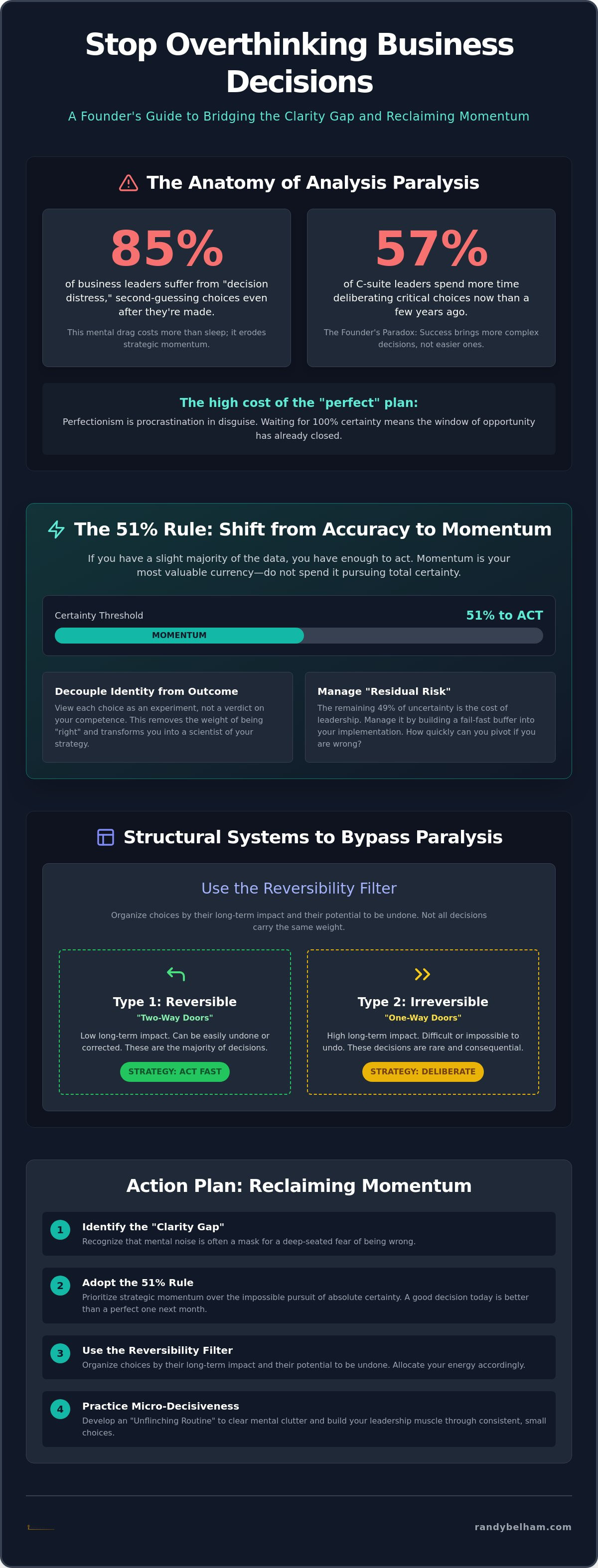
Reclaiming Momentum: A Founder’s Action Plan
You built the engine. Now you are clogging the gears. Indecision is a slow leak in your hull. It is the most expensive option on the table. To stop overthinking business decisions, you must realize that "no decision" is actually a choice. It is a choice to remain stagnant while the market moves past you. Reclaiming your momentum requires an unflinching look at your internal systems—from leadership mindset to physical operational components. If you are looking to optimize your industrial infrastructure, you can visit Jealco International, Inc. to explore specialized material handling systems. It is time to shift from contemplation to execution.
Clarity is not found in a spreadsheet. It is found in the discipline of your day. You need a routine that protects your cognitive load. You need to build the muscle of decisiveness in the small moments so it is ready for the large ones. This is the inner game of leadership. It is about managing your emotional state before you walk into the board room. If your internal environment is cluttered, your external strategy will be too.
Morning Rituals for Mental Space
Silence is a luxury. For a founder, it is a necessity. You need a window of quiet before the digital noise of Slack and email begins. Use this time to identify your "One Big Move" for the day. Do not look at a list of twenty tasks. Identify the one move that actually shifts the needle. Minimize trivial choices by structuring your environment. Wear a uniform. Eat the same breakfast. Save your mental energy for the C$100,000 problems, not the C$10 ones. Discipline in the mundane creates freedom for the strategic.
The Post-Decision Audit
Stop judging your past self with today's knowledge. It is a trap. Audit your choices based on the information you had at the time. If the process was sound, the decision was correct, even if the outcome was unexpected. Identify your patterns. Do you hesitate because of a fear of conflict? Are you paralyzed by a fear of loss? Recognizing these triggers allows you to bypass them. You can explore these performance metrics further by reading about an executive coach for entrepreneurs who focuses on the founder's psychological edge.
Your vision deserves a leader who acts. If you are tired of the mental loops and ready to reclaim your strategic focus, 1:1 Private Coaching provides the high-touch support needed to bridge the clarity gap. Stop waiting for the fog to lift. Start moving through it.
The Case for a Private Advisor: Accelerating Clarity
You have the strategy. You lack the silence. Your office overlooks the city, yet your vision is clouded by the noise of a thousand minor variables. This is the weight of the C-suite. It is a solitary burden. To stop overthinking business decisions, you often need more than a framework. You need a mirror. A private advisor provides the "Calm Anchor" in your storm of ideas. They don't offer more data. They offer a perspective that is untethered from your internal politics.
Montreal's high-growth ecosystem moves with a specific intensity. For founders in this market, a peer-level perspective is not a luxury. It is a competitive necessity. You are navigating the distance between your daily operational tasks and your long-term strategic vision. It is easy to lose the signal in the static. An advisor helps you bridge that gap. They provide the structural quiet required to see the move before you make it. This is about moving from a state of reaction to a state of presence.
The "ClearSight" methodology is designed for this exact tension. Whether in a group setting or 1:1 private advisory, it strips away the non-essential. It forces you to confront the "Inner Game" that dictates your outer results. You aren't just solving a business problem. You are refining the instrument that makes the choices. When you sharpen the mind, the decisions become effortless.
The Value of a Neutral Sounding Board
Internal teams are valuable. They are also biased. Your VPs and directors have a stake in the outcome. Their advice is filtered through their own departmental goals. An advisor only has your clarity in mind. They are the only person in the room who isn't afraid to tell you when you are over-complicating a Type 2 door. This neutrality is where the breakthrough happens.
Working with a private advisor allows you to move beyond the tactical. You stop asking "What should I do?" and start asking "Who am I becoming through this choice?" This is the psychological depth required for Empowered Leadership. By limiting the roster to only ten private clients, the support remains high-touch and exclusive. You aren't a number in a coaching factory. You are a partner in a high-stakes dialogue.
Next Steps: From Paralysis to Presence
Acknowledge the weight you are carrying. It is heavy. It is also optional. You can decide to put it down today. The loop of "what-if" scenarios ends when you choose to trust a structured process over a chaotic internal monologue. To stop overthinking business decisions, you must step out of the noise and into a space of reflection. Momentum is waiting for you on the other side of the Clarity Gap.
Your business cannot outgrow your capacity to decide. If you are ready to reclaim your focus and lead with disciplined composure, the path is clear. It begins with a single conversation. It ends with a transformed leadership presence.
Reclaiming Your Strategic Focus
Your vision deserves a leader who moves. Hesitation is a high-interest loan against your future growth. You have the frameworks to bridge the clarity gap. Use the 51% rule to prioritize momentum. Implement structural filters to separate the irreversible from the tactical. It is time to stop overthinking business decisions and reclaim your mental space. Your internal state dictates your external results. Quiet the noise. Trust the process.
Finding that structured quiet is easier with a peer-level advisor. Randy Belham offers a unique blend of 30 years of business experience and 20 years of high-performance coaching. Based in Montreal, he limits his private advisory to ten clients to ensure deep, intimate support. Through the ClearSight and Empowered Leadership programs, he acts as a calm anchor for founders navigating complexity. You don't have to carry the weight of uncertainty alone.
The fog will not lift on its own. You have to walk through it. Your next move is waiting. Start today.
Frequently Asked Questions
How do I know if I am overthinking or just being thorough?
Thoroughness has a finish line; overthinking is a loop. If you are revisiting the same data without finding new insights, you have crossed the line. Thoroughness leads to a clear decision. Overthinking leads to mental exhaustion and stalled growth. You aren't finding more answers. You are just finding more questions to hide behind.
What is the "Clarity Gap" in business decision-making?
The Clarity Gap is the distance between your current mental noise and your strategic vision. It is the friction caused by unresolved choices. When you stop overthinking business decisions, you close this gap. It allows your vision to translate directly into action without the interference of constant "what-if" scenarios. It is about reclaiming your momentum.
Can overthinking lead to founder burnout?
Yes, chronic indecision is a primary driver of psychological burnout. Carrying "open loops" in your mind drains your cognitive battery. It creates a state of constant high-alert without the relief of resolution. You aren't tired from the work itself. You are tired from the waffling. The mental drag of hesitation is heavier than the labour of execution.
How does the 51% rule work for high-stakes decisions?
The 51% rule dictates that once you have a slight majority of the necessary data, you must act. In high-stakes environments, waiting for 90% certainty is often a fatal delay. You use the 51% to move and the remaining 49% to adjust. Momentum is your best risk-mitigation strategy. Speed is a competitive advantage that data cannot replace.
Why do I struggle to make decisions even when I have all the data?
You aren't looking for data; you are looking for a guarantee. This is a common hurdle for those trying to stop overthinking business decisions. Data provides context. It cannot remove the risk of being wrong. The struggle is emotional, not informational. It is a fear of the visceral weight of failure. You need a system to manage the fear.
How can a coach help me stop overthinking my business?
A coach acts as a neutral sounding board to filter your internal noise. They provide the structural systems, like ClearSight, to help you categorize choices. By identifying the "Inner Game" triggers that cause you to stall, an advisor helps you move from paralysis to presence. It is about having a peer-level anchor while everything else is in motion.
What is the difference between a Type 1 and Type 2 decision?
Type 1 decisions are irreversible "one-way doors," like a major acquisition. They require deep analysis. Type 2 decisions are reversible "two-way doors," like a new marketing headline. Most founders treat Type 2 choices as Type 1. This mistake creates unnecessary friction and kills your operational speed. Learn to recognize the difference and move accordingly.
Is it possible to be too decisive as a leader?
Rashness is not decisiveness. True decisiveness is grounded in a structured process and a calm presence. If you act without any data or reflection, you are being impulsive. The goal is a disciplined composure that values velocity but respects the gravity of high-impact choices. You want to be steady, not just fast. Presence requires both.



Comments