
Developing a Founder’s Mindset: The Inner Game of High-Stakes Leadership

What if the primary bottleneck in your organization isn't your strategy, but the way your brain processes stress? You've reached the milestones. You've built the enterprise. Yet, the weight of every decision feels heavier than the last. The isolation is real. Developing a founder's mindset is the only way to survive this level of pressure without losing your edge. Decision fatigue isn't just a buzzword. It's a structural failure in your internal operating system. You realize that the tactics that got you here won't be the ones that keep you steady.
You're likely exhausted by chronic overthinking. It's a common tax on high-stakes leadership. I'll show you how to rewire your brain for these unique pressures through structural clarity and emotional regulation. We'll move past the noise and focus on the inner game. This article provides a framework to help you shift from operator to owner, ensuring mental clarity and sustainable high performance. We'll explore how to bridge the gap between external demands and internal composure.
Table of Contents
What is a Founder’s Mindset? Beyond the Hustle Narrative
The revenue hits record highs. Your sleep hits record lows. This is the unspoken reality of the high-stakes leader. Many believe that success is a matter of sheer will. They think the "hustle" is the strategy. It isn't. Success at this level is about the architecture of your thoughts. Developing a founder's mindset is not about adopting a new personality. It's about upgrading your psychological operating system. It's the difference between being the engine and being the engineer.
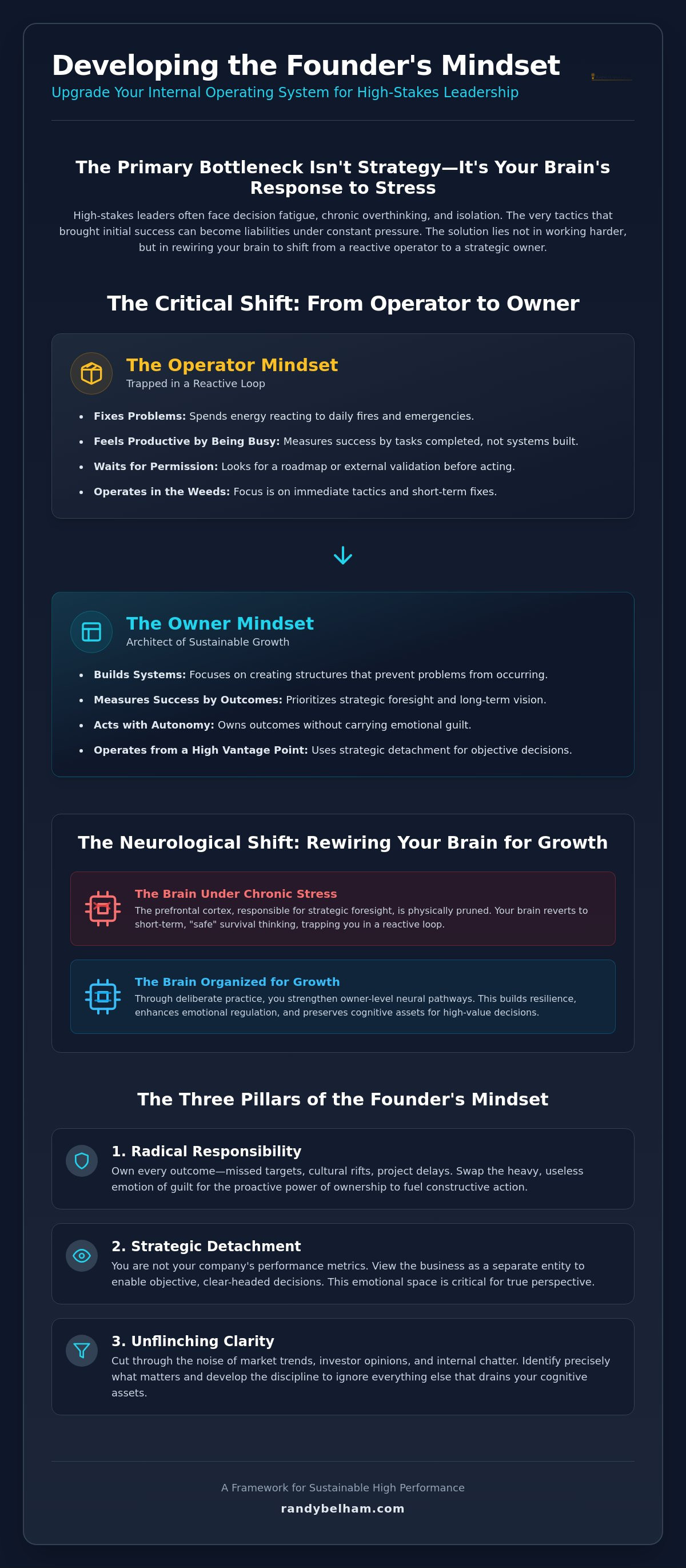
Most leaders remain stuck in the "Operator Mindset." They are excellent at fixing problems. They react to fires. They feel productive because they're busy. But an "Owner Mindset" is different. Owners don't fix problems; they build systems that prevent them. To understand the depth of this shift, one must ask: What is an entrepreneurial mindset? It's a framework for processing uncertainty. In the 2026 market, where Montreal startups are scaling with leaner teams and AI-driven speed, emotional regulation is the only thing that keeps the structure from collapsing. If you can't regulate your internal state, you can't lead an external organization.
The Three Pillars of the Founder Mindset
Radical Responsibility: You own the outcome. Every delay, every missed target, every cultural rift is yours. But you don't carry the guilt. You realize that guilt is a heavy, useless emotion. You swap it for ownership.
Strategic Detachment: You are not your EBITDA. When the business suffers, you don't have to suffer. Learning to view the company as a separate entity allows for objective decision-making. It creates the space needed for true perspective.
Unflinching Clarity: The Montreal market is noisy. Venture capital trends shift. Tax rates fluctuate. Clarity is the ability to cut through that noise. It's about knowing exactly what matters and ignoring everything else.
Why Traditional Executive Training Often Fails Founders
Corporate training is designed for managers. It teaches you how to maintain what already exists. It focuses on following a roadmap. Founders don't have a map. They're building the road while they're driving on it. Developing a founder's mindset requires resilience that a classroom can't provide. You might be stuck in "Employee Mode" if you're still waiting for permission to pivot. You don't need permission. You need a system. Traditional coaching often misses the "Inner Game." It ignores the isolation. It overlooks the visceral weight of high-stakes leadership. True growth happens when you realize that your biggest bottleneck is the way you think.
The Neurological Shift: How to Organize Your Brain for Growth
Your brain is a plastic organ. It reshapes itself based on the demands you impose. In high-pressure leadership, this is either your greatest asset or your silent saboteur. Developing a founder's mindset requires understanding that your neural pathways aren't fixed. You can rewire them. But there's a cost to the chaos. Chronic stress doesn't just feel bad. It physically prunes the prefrontal cortex. This is the part of your brain responsible for strategic foresight. When stress is constant, your ability to think three years ahead vanishes. You become trapped in the next three minutes.
Under extreme pressure, your brain naturally seeks safety. It reverts to "safe" employee-style thinking. You look for a boss who isn't there. You crave a roadmap that doesn't exist. This is a biological survival mechanism. To counter this, you must engage in "Deep Work." This isn't just about productivity. It's about strengthening owner-level neural pathways. Developing a founder's mindset involves forcing your brain to Defining the Founder's Mindset through consistent action. You move from being a passenger in your own mind to being the navigator.
Rewiring Your Response to Uncertainty
Uncertainty is the founder's default state. Most people's brains treat market fluctuations as a physical threat. Your amygdala fires. Your vision narrows. You enter "Threat Response." High-stakes leadership requires training the amygdala to remain quiet. You must move toward "Opportunity Analysis." This isn't positive thinking. It's structural regulation. Practice identifying the physical sensation of stress. Realize it's just data. Once you name the response, you can choose a different path. This is the focus of 1:1 Private Coaching.
The Habit of Decision-Making Clarity
Decision-making is a finite cognitive asset. Every choice you make, from your morning coffee to a million-dollar acquisition, drains the same battery. You've likely experienced decision fatigue. Your choices become impulsive. Or worse, you stop choosing altogether. Protect your highest-value cognitive assets. Structure your day to tackle the hardest problems when your clarity is at its peak. If you find yourself stuck, learn how to stop overthinking business decisions. Clarity is a habit, not a gift. It requires a disciplined structure to maintain.
The Founder’s Paradox: Why Grit Alone Leads to Burnout
The revenue numbers are climbing. Your personal life is a ghost town. This is the Founder’s Paradox. You believe that more effort will solve the problem. You think the solution to a complex systemic issue is simply to work harder. It's a seductive lie. Developing a founder's mindset requires you to realize that grit has a ceiling. Beyond that point, grit without grace is just a slow-motion collapse of leadership. Your biggest strengths, the very things that launched this enterprise, are now your greatest liabilities.
Obsession served you well in the early days. Now, it prevents you from delegating. Speed allowed you to outpace competitors. Now, it causes you to overlook critical details. This is the "Clarity Gap." It's the distance between your current capacity and the demands of a scaling business. If you don't bridge this gap through psychological restructuring, you'll hit a wall. You can't out-hustle a structural mental deficit. You need a different operating system.
Busting the Myth of the "Always-On" Founder
Constant availability is not a badge of honour. It's a symptom of a broken mindset. If you are always on, your systems are always off. You are functioning as a high-priced operator rather than an owner. There is a profound difference between being productive and being present. True leadership requires presence. It requires the space to think, not just the energy to react. You can read more about entrepreneur mental resilience to understand why the "tough founder" narrative is often a path to failure. Resilience is about recovery, not just endurance.
Navigating the Isolation of the Top Seat
Montreal is a vibrant hub. Startups here raised $9.0 billion between 2020 and 2024. The energy is palpable. Yet, in the centre of that growth, you feel alone. The isolation of the top seat is heavy. You are the final word on every decision. You carry the weight of every employee's livelihood. This isolation distorts your perspective. It turns small problems into existential threats. Without a private partner to navigate this noise, your growth slows. You start playing not to lose, rather than playing to win. Developing a founder's mindset means finding a way to stay grounded while everything else is in motion. It's about finding a calm anchor in the storm of high-stakes leadership.
Mindset Coaching for Business Owners: Building the Structure
General life coaching focuses on balance. Mindset coaching for business owners focuses on the edge. It is not about being "better" in a vague, aspirational sense. It is about being effective under extreme pressure. Developing a founder's mindset requires a partner who understands the mechanics of high-stakes performance. You need a "Calm Anchor." This is someone who remains steady while your market fluctuates. They provide the stabilizing perspective required to bridge the Clarity Gap before it swallows your progress.
Greatness is built on an "Unflinching Routine." It is the disciplined work that makes the strategic work possible. Without structure, you are merely reacting to the loudest fire. With structure, you are leading. You must recognize the blind spots in your leadership. You cannot see the label from inside the bottle. External perspective is the only way to realize where your personal limitations are masquerading as business hurdles. It's about moving from a state of mental noise toward a sense of structured quiet.
The Mechanics of Mindset Coaching
Limiting beliefs often hide as "business logic." Saying "I am the only one who can do this" is not a strategy; it is a fear. In Montreal, leading a diverse, high-growth team requires exceptional emotional intelligence. You need to understand the subtext of every negotiation. Use a "Decision Journal." Track your internal state when you make significant calls. Optimize your inner game by reviewing these entries. This process helps you identify patterns in your thinking that lead to either breakthrough or bottleneck.
Developing Leadership Presence and Grit
True authority is quiet. Authoritarianism is loud. It is a mask for insecurity. When you possess internal quiet, you command external influence. People follow the person who is not panicked. This presence is a skill you can develop. It is the relationship between your internal state and your external impact. If you want to master this, consider the benefits of founder performance coaching. You will learn to project authority without the need for force.
Ready to build a more resilient internal operating system? Explore 1:1 Private Coaching to secure your spot among the limited ten-client advisory and start closing your Clarity Gap today.
Private Advisory: Navigating the Montreal Entrepreneurial Ecosystem
Success in Montreal has a specific weight. The city is a bilingual engine of innovation. Over 1,045 startups now operate in the metro area. Their cumulative enterprise value has reached $59.3 billion. These are the metrics of success. They hide the internal noise. Developing a founder's mindset in this environment requires more than just a global strategy. It requires local nuance. You are navigating a province with specific innovation strategies and tax structures. You are building in a hub where AI startups raised over $800 million in 2024 alone. The pressure to scale is immense. The isolation is equally vast. You realize that the external growth is outpacing your internal quiet.
The Montreal Advantage: Leading with Sophistication
Montreal founders face a unique paradox. You must be global in reach but local in culture. This creates a specific type of mental friction. Finding clarity in a high-growth environment is difficult when you are the final word on every decision. Randy Belham’s 30 years of business experience provides a stabilizing perspective for this exact tension. He has moved beyond the need for external validation. He acts as a peer to high-achievers. He understands the Quebec market. He knows that a $7.5 billion provincial innovation strategy is useless if the leader at the centre is paralyzed by overthinking. He provides the grounded presence required to navigate the noise.
Taking the Next Step Toward Mindset Mastery
There is a limit to what you can learn from a guide. Reading about mental resilience is not the same as practicing it while a critical deal collapses. You need a partner to realize your blind spots. This is the value of a limited-capacity private advisory. It is the "Rule of Ten." By limiting advisory to only ten clients, the focus remains deep. It is exclusive. It is high-touch. This ensures every conversation has the space to move from observation to insight without distraction. It is for the leader who has moved past general coaching and needs a sharp, perceptive advisor to manage the inner game.
You are ready for this partnership when the "Clarity Gap" becomes too wide to ignore. Strategy is the vehicle. Mindset is the fuel. Without the right fuel, the vehicle stalls regardless of its engineering. Developing a founder's mindset is the work of a lifetime, but it begins with a single decision to stop going it alone. It is time to transition from operator to owner. It is time to find your anchor. Start the process of reclaiming your mental clarity.
Master the Inner Game
The weight of leadership is constant. The noise of the market is permanent. You've learned that grit alone is a finite resource. It's a bridge to burnout. Real growth requires a structural shift in how you process pressure. Developing a founder's mindset is the work of moving from the chaos of the operator to the clarity of the owner. It's about rewiring your response to uncertainty. It's about protecting your cognitive assets. You can't lead an organization if you can't regulate your own mind.
You don't have to navigate the isolation of the top seat alone. Montreal is a high-velocity environment. It demands a leader who is both present and precise. Randy Belham provides a stabilizing perspective as a Montreal-based executive authority with 30 years of business experience. With a strict limit of ten private clients, the focus is absolute. It's high-touch. It's the partner you need to close the Clarity Gap. Your enterprise reflects your internal state. If you want a different result, upgrade the operating system. You have the capacity for greatness. You just need the structure to sustain it.
Frequently Asked Questions
How long does it take to develop a founder’s mindset?
Structural shifts in your internal operating system typically emerge within three to six months of consistent work. It's not a destination; it's an ongoing evolution. You'll likely notice improved decision-making clarity first. Developing a founder's mindset isn't a sprint. It's a deliberate rewiring of how your brain processes uncertainty and high-stakes pressure. Consistency in your inner game is the primary driver of speed.
Is mindset coaching for business owners different from executive coaching?
Executive coaching often focuses on performance metrics, management tactics, and external targets. Mindset coaching targets the internal state. One fixes the business. The other fixes the leader. Developing a founder's mindset requires addressing the psychological weight that traditional corporate training ignores. It's about finding a calm anchor within yourself to navigate the noise of a scaling organization.
Can an employee develop a founder’s mindset before starting a business?
You can adopt this perspective immediately. Start by taking radical responsibility for your current outcomes. Shift from asking for permission to proposing systems. It's about moving from a "permission" mindset to a "creation" mindset. This psychological foundation makes the eventual transition to business ownership less jarring. You are practicing the inner game before the stakes are at their peak.
What are the most common mindset blocks for entrepreneurs in Montreal?
Founders in Montreal often struggle with the "Clarity Gap" between local operational demands and global scaling goals. Isolation is a significant hurdle in the Quebec ecosystem. Many feel the visceral weight of every employee's livelihood while navigating bilingual leadership pressures. This often leads to chronic overthinking. They get stuck in the noise of the market instead of maintaining a singular strategic vision.
How do I know if my mindset is the reason my business isn’t scaling?
Look at your decision-making process. If your team is capable but you are still the final word on every minor choice, you are the bottleneck. Your internal limits have become the company's ceiling. When growth stagnates despite sound strategy, it's often because your capacity for uncertainty has reached its limit. You are likely playing not to lose rather than playing to win.
Is it possible to develop a founder’s mindset while suffering from burnout?
It's possible, but the approach must change. You have to stop valuing "grit" above all else. Burnout is a sign that your current operating system has failed. Rewiring your brain for growth starts with valuing recovery and presence. You cannot build a sustainable enterprise on an empty battery. Realize that resting—whether through a quiet weekend or a morning at the range with supplies from Golf Ball Monkey—is a strategic requirement, not a sign of weakness.
How often should I work with a mindset coach?
Consistency matters more than frequency. Most high-stakes leaders benefit from bi-weekly sessions. This rhythm provides enough space for execution and enough frequency for reflection. It ensures you have a stabilizing perspective to help you navigate the noise of the market before it becomes overwhelming. It's about maintaining a disciplined structure for your highest-value cognitive assets.


Comments